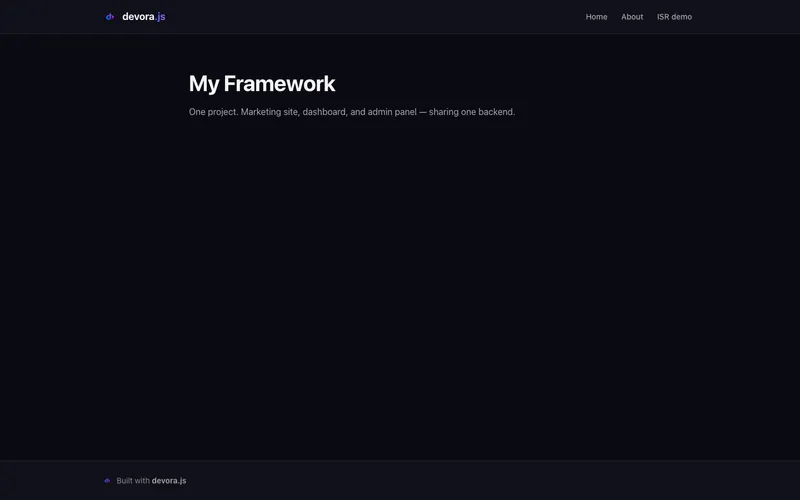
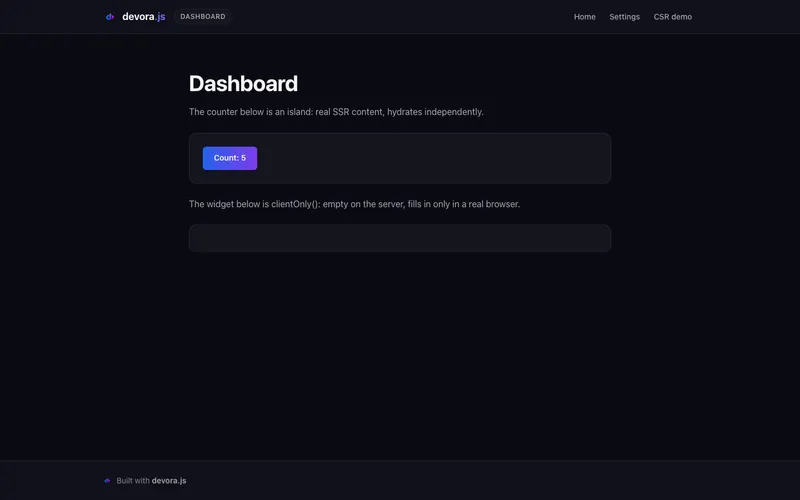
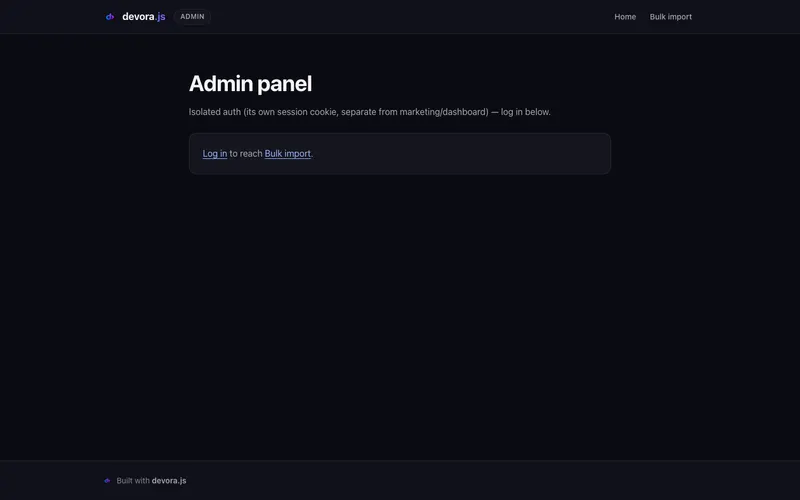
Small, runnable projects that each show one thing Devora.js does, and the framework's own example apps running on a real host.
Runnable examples
Each one is a standalone project in the framework repo's examples/ folder that installs the published packages from npm. CI installs, typechecks, builds and sends real requests to every one, so they don't go stale. Node 20 or newer.
Marketing site + dashboard + shared API
The multi-app default: a public site, a logged-in dashboard and a JSON API sharing one backend function and one login. A token from the API is accepted by the dashboard.
site · auth none
app · shared
api · shared, backend-only
git clone https://github.com/hassanalsa3aka/devora.js.git
cd devora.js/examples/multi-app
npm ci && npm run dev
Live updates (WebSockets) with a separate realtime server
A dashboard that updates without a reload: a login-protected token route, a small Socket.IO server with one room per user, a publish call from the app, a polling fallback, and the CSP setting that lets the browser connect.
app · shared
realtime/ · plain Node (Socket.IO)
git clone https://github.com/hassanalsa3aka/devora.js.git
cd devora.js/examples/realtime
npm ci && npm run dev
Background jobs: a queue with a worker, and a schedule
Three ways to run work outside a request: BullMQ with Redis and a worker, a SQLite queue with a worker, and node-cron in the server. The Redis part of its check skips when Redis is not installed; the rest always runs.
api · shared, backend-only
workers/ · plain Node
git clone https://github.com/hassanalsa3aka/devora.js.git
cd devora.js/examples/background-jobs
npm ci && npm run dev
The three example apps from the devora.js repo — one project, three apps, three auth modes — deployed by the maintainer on Vercel and on Netlify. Source: apps/ on GitHub. The Vercel deployments were checked October 14, 2026. The Netlify deployments are the same apps, checked by the maintainer.